 +1 6477241694
 +44 2039 960 991
 +91 78900 99810
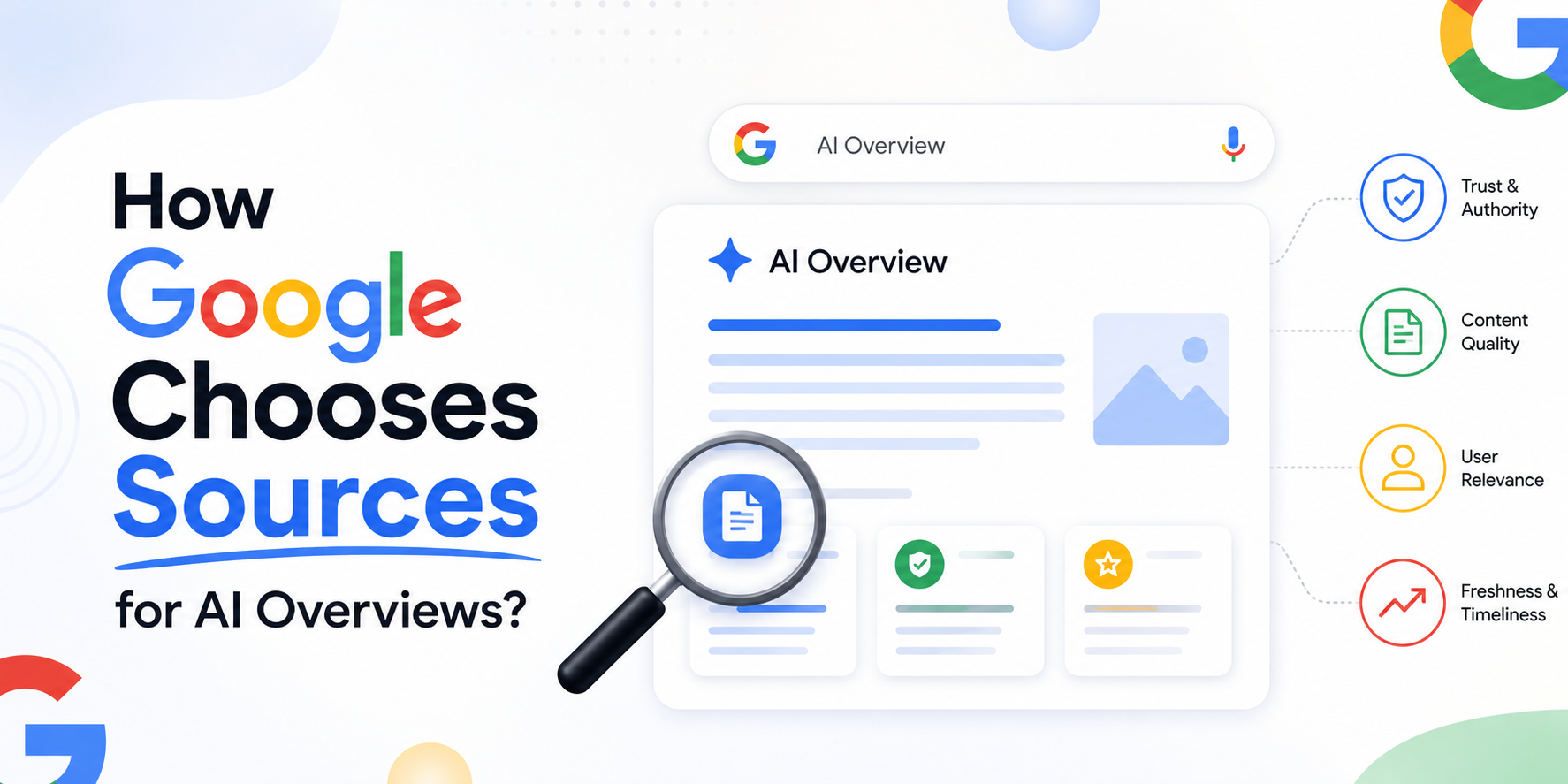
It’s the time when businesses should rethink their SEO strategy. They must consider Google AI overview ranking factors. Whether it is entity optimization, relevance, building topical authority, or technicalities, they should decide it faster.
Google search trends are changing. Around 65.4 % of searches don’t result in a website visit in 2026. This is called the zero clicks. So, where are these clicks going? AIO or AI Overview is the major reason for eating the clicks. It is an AI-generated summary. Users get a clear answer to their queries. They feel satisfied and have no need to engage with the website directly.
It’s a dramatic shift in organic search results. Websites that used to get massive traffic and leads only through organic ranking are facing challenges. The clicks and conversions get reduced for top-ranking sites across the industries.
However, many businesses have entered into their growth era only from an AI overview citation. For example, a health care publishers gain 38% CTR from AI citations.
Key Takeaways
- Many of the pages referenced within AI overview articles have already achieved good organic link performance. Technical SEO, content quality, and topical authority are critical fundamentals.
- Pages that contain direct responses to inquiries, have quick readability, provide exclusive views, or relate to direct experience, may be referenced more than those pages that repeat pre-existing information.
- Instead of creating hundreds of articles, build comprehensive content around your core topics and connect them through strong internal linking.
- As more users get answers directly from Google AI Overviews, businesses should track not only their organic rankings but also whether their content is being cited by AI.
Google AI Overview Optimization Checklist
| Ranking Factor | What Google AI Looks For | What You Should Do |
|---|---|---|
| Search Intent Match | A page that answers the user’s question directly | Understand the intent before creating content and answer it within the first few paragraphs. |
| Topical Authority | Comprehensive coverage of a subject | Build content clusters that cover definitions, comparisons, FAQs, examples, and related topics. |
| EEAT Signals | Expertise, experience, authority, and trust | Add author expertise, cite reliable sources, and publish first-hand insights whenever possible. |
| Original Information | Content that offers something new | Include case studies, original research, unique frameworks, or real-world experience instead of repeating existing content. |
| Content Structure | Easy-to-read, well-organized content | Use descriptive headings, short paragraphs, bullet points, and tables to improve readability. |
| Technical SEO | Pages that Google can easily crawl and understand | Improve Core Web Vitals, mobile usability, schema markup, indexing, and page speed. |
| Entity & Brand Signals | Strong brand recognition across the web | Build your online presence through backlinks, reviews, business listings, and consistent branding. |
| Freshness | Up-to-date and relevant information | Refresh existing content regularly with new data, examples, and “Last Updated” timestamps. |
What Are Google AI Overviews?
Google AI overviews (AIO) are the AI summaries powered by Google’s Gemini model. They give direct answers, combining information from multiple resources. AI overviews appear at the top of organic search results.
So, how does AI give an answer? It understands the intent, analyzes the top ranking pages on Google and relevant available information, and then gives new or better answers.
Not just the simple topic, AIO can also handle complex questions, giving detailed analysis and automatic follow-up answers.
How AI Overviews Select Citation Sources?
The TTC team has been working on AI SEO for a while. We have closely researched AI overviews cited in resources. After working 1.5 years, we have noticed a similar pattern to AI citations.
Google AIO uses core and non-core resources. Core sources are mainly those highly ranked websites on Google or other search engines. Its website typically has the highest topical coverage. Their content answer matches the user’s intent clearly and demonstrates strong expertise.
Non-core resources don’t always provide the exact answers. However, they validate facts, context, and support specific claims. We also noticed non-core resources often bring a unique perspective.
From our real research, we somehow decoded the AI overview algorithm to some extent.
Here is how Google chooses AI overview sources:
-
Entity / Brand Presence and Domain Authority
Domain authority matters even more. It also added to entity SEO and brand presence. Domain rank and brand reputation are foundational. It signifies your brand credibility and how the whole industry sees your site.
-
Semantic Structure
Semantic relevance over keyword matching is one of the Google AI overview ranking factors. It assesses page-to-page relevance and distributed authority. It considers the topical cluster, which means the topic coverage, and descriptive anchor text written in organic language.
-
Organic Rank and Positions
Overviews use Google’s existing search index as their retrieval layer. We have noticed that Google usually uses around 8 to 11 websites to build a single AI Overview. Only in a few cases does it go much deeper.
When we researched those cited websites’ organic rank, we found they all exist within the first 30 sources. Roughly 14% of AI Overview citations come from URLs outside the top 100. It proves that relevance, authority, and content quality are still vital for an AI overview algorithm.
-
EEAT Content
Gemini is a Google product, so it relies on the same existing trust infrastructure. That’s Google’s EEAT framework despite the trust, intent match, and quality signals. Hence, the credible, highly expert, and authoritative content is likely to get cited faster.
-
Clear and Direct Answers
Pages that give clear and quotable answers in every paragraph get mostly cited. If your page answers the user’s question in the first one or two paragraphs, it is likely to appear in AI Overviews.
-
Topical Coverage
A single AI Overview might pull sources from 8+ different pages across the original query. It gives an understandable or exact answer by combining subtopics from different research. That’s why a page that covers adjacent subtopics, definitions, common questions, comparisons, and exceptions to the core topic is likely to get cited by the AIO.
When Will Google AI Not Cite Your Content?
From what we’ve observed, Google AIO is less likely to cite pages that are difficult to access or don’t add much value.
In addition, if your site requires login or registration to view the information, or if the information is similar to what multiple sources are publishing, the likelihood of your pages being cited by Google will be much less.
We’ve also noticed that pages with poor formatting, unclear answers, or unsupported claims—especially on health, finance, or legal topics—rarely appear in AI Overviews. The easier your content is to read, trust, and understand, the better your chances of becoming one of Google’s cited sources.
How to Become a Source of AI Overview Citation?
Start with SEO
We researched 200+ queries. The results show over 90% of sources cited in AI Overviews already rank in the top 10 to 11 organic results for that query. AI overview citation and organic SEO are related, so keep the basic of your organic ranking, stable.
Target the right keyword and improve content quality. Try to get a high-quality backlink. Improve web presence with online listing and encourage reviews. Do every on-page, off-page, or technical SEO that can improve the chance of getting a good organic rank.
Add Schema Markup and Structured Data
The AI overview algorithm prefers structured data even more. For that, take the help of a schematic markup. Implement different schema matching for search queries. This may include FAQ page, Implement FAQPage, HowTo, Article, and Organization schemas. Use related schemes to people and products. This will help the bots to read and understand the context more clearly.
Build Topical Depth through Content Clusters
Cover the full landscape of your topic area, not just the primary. Give a comparison, drawbacks, or even any search topic related to the main topic. Cover every aspect of the area comprehensively. Make sure each piece of content answers the core question very clearly. Interlink your pages so Google can understand how they relate.
Create Something No One Else Has
From what we’ve observed, Google compares information from several pages before generating an AI Overview. If multiple websites say exactly the same thing, your page may not be selected as a citation. That’s why giving a fresh perspective is very crucial.
Try to produce original research and proprietary data. Give real case study results, or a unique framework that differentiates your content in a way that is purely curated from your first-hand experience.
Update and Add Fresh Content
Don’t have to produce 100 blogs a month. Instead, add a new perspective to your old blogs. Update the data, include a new subtopic. And, mark content with visible “Last Updated” timestamps.
Keep Your Website Fully Technically Optimized
Technical SEO is the fundamentals. Otherwise, you will never crawl or cite your site. Optimize the page experience, like page speed, loading time, etc. Make sure the page has proper index tags and canonical tags. Meet the benchmark of Core Web Vitals. Use a clean HTML structure. Mobile friendliness is also vital.
Measure Your AI Overview Presence
Utilize the AI Overviews view in Google Search Console for clicks & impressions. Then, validate against manual search results (logged out/Incognito) for your 20-30 most significant queries. You can also use third-party tools like Semrush and Ahrefs to obtain AI Overview visibility; however, as of this writing, no tool has 100% visibility on AI Overview appearances.
Final Thoughts
To be honest, AI citation has become a challenge for many businesses. However, that day is not too far when people will leverage its goodness.
AI and organic SEO are of interest at many points. So, it’s always better to start with the area you know already, Strength technical SEO, build on page, and improve domain rank with off-page SEO. You will be halfway there.
Do you need any support for AI SEO? We can help you. Book a free consultation with us today!
Frequently Asked Questions
How can I increase my chances of getting cited in Google AI Overviews?
Start by building strong SEO fundamentals. Create content that answers questions clearly, covers the topic and subtopics in depth. Try offers something original, such as original research, studies, or statistics that other websites don't. Good technical SEO, structured data, internal linking, and regular content updates can also improve your chances over time.
Will AI Overviews replace traditional SEO?
No. AI Overviews are changing how people discover information, but they still rely heavily on Google's search index. In our research, the most cited pages already ranked well organically. That's why traditional SEO remains the foundation—AI optimization simply builds on top of it.