Let’s understand a scenario first. Visitors arrive on your landing page, scroll a bit, and leave without taking action.
Can you call it a traffic problem? Of course, not, because that’s a landing page problem.
On average, landing page conversion rates range between 2.35% and 6.6%.
That means, a good volume of potential leads you can lose simply because you are not following landing page best practices.
And yet, 43.6% of marketers rely on landing pages as their primary lead generation tool. This tells us one thing clearly: an effective landing page can do wonders for your business.
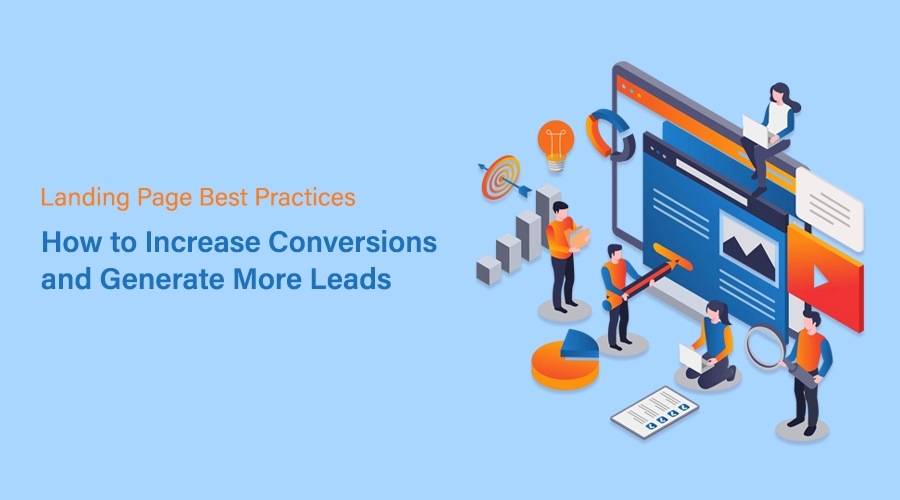
In this blog, we will share some practical tips on landing page design and development.
These you can follow to increase conversions and generate more qualified leads, or meet a specific goal.
But, before we begin, let’s understand:
- What’s usually going wrong with landing page layout and functionality?
- Which aspect of the landing page costs businesses the most?
They are:
- Lack of value proposition
- No brand identity
- Unclear path to conversion
- Misalignment with campaign goals
- Slow loading time
- Unclear CTAs
- In consistent ad creative [copy + visuals]
What Are the Landing Page Best Practices to Bring Conversions?
Keep the Key Action above the Fold
he ‘above the fold’ on your landing page design is the section that visitors see before taking the first scroll.
You should create this section this way, so that users can get an answer quickly to:
- What is this?
- Who is it for?
- Why should I care?
The elements you should keep in this section are:
- A clear headline
- A clear CTA [aligned to the main goal]
- The USP of your products or services
- A simple introduction to your business
Maintain a Visual Hierarchy
The landing page layout is one of the most important aspects of landing page best practices.
Adjust the heading, subheading, and white spaces in such a way that readers can scan the page easily.
Follow this simple rule of thumb: you want to direct the reader from the main message to supporting details, and finally to the action.
Talk Directly about Problems or Benefits in the Main Heading
Modern buyers expect clarity.
Hence, as a starting point on your landing page, your heading should reflect that. Address the problems or benefits directly in the heading.
It gives psychological assurance to the audience to stick with the rest of the page.
Use a Short Form with Only Essential Fields
The ‘lead capturing form’ is another important element on your landing page design.
But most businesses make a mistake here. They make the form overcomplicated as they think this is the best use of it.
No, it goes against the landing page best practices. Most of your users will actually drop off while submitting the details.
If you don’t want to make this happen, make sure:
- Keep the space for the most essential details only.
- Use minimalist form design.
- In case having more details will help, have multi-step forms.
Optimize Your Landing Page for the Right Device
Optimizing the landing page design for all the targeted devices is essential.
A little assumption here can go a long way. We will tell you how!
Firstly, once the page goes live, track where your targeted traffic is coming from. And, later, optimize the layout for those devices.
If it is not the case, use your intuition here.
For instance, if you are targeting people on the go, targeting the small screen resolution, especially for smartphones, is essential. Make sure buttons, forms, and text are easy to use without zooming.
While targeting the B2B clan, optimizing the landing page for multiple devices is vital.
Use Clear Visuals to Demonstrate Services and Products
Use clear images, diagrams, or screenshots to demonstrate your services and products.
You can also use real pictures of its usage, demo videos, or animations. This is an vital tips if you are creating a social media landing page.
This landing page’s best principle will help you in two ways:
- Customers can relate the products to their real-world experience.
- You will gain attention and engage more targeted customers.
Plan the Navigation Only on a Single Goal
We know, it’s very tempting to use a landing page to explain everything, especially when you are using a longer scroll page.
It can actually lead to confusion for users,
Because it will never be able to give clarity, the visitors, don’t know where to focus.
You should use your landing page design only for a single outcome.
Remove unnecessary links and distractive navigation that pull visitors away from the main action. In fact, use a consistent CTA that takes the audience in a single direction,
When there’s only one clear path, decision-making becomes easier.
Guide Visitors to Take Scrolls and Explore All Angle
When you use a long scroll landing page, you actually get the scope to engage more users.
So, how can you make the most of such an opportunity?
- Use subtle cues like layout flow, content sequencing, or visual prompts.
- Implement a smooth scrolling experience
- Place CTA Strategically
- Use contrasting page color
- Use consistent typography that goes with the branding philosophy
Highlight Social Proofs
B2B and B2C decisions rely heavily on trust.
And guess what? You will get only a few seconds to earn such accountability,
So, what helps here?
- Testimonials, client logos, case outcomes, or brief endorsements using them reassure visitors.
- To make your efforts more effective, we would say place social proof near key decision points, not hidden at the bottom.
Test Whether the Key Message is Comprehensible
Before taking the page live, test the page with someone outside.
If they can’t explain what the page offers and what to do next within a few minutes, the ad copy and design need refinement.
Best Practices for Building Effective Landing Pages: What Works and What Doesn’t?
Let’s know some dos of landing page best practices
Use Clear and Compelling Ad Copy
Make landing page copy clear, simple, and compelling. It should clearly match the promise made in your ad, email, or PPC campaign. If the copy is vague or unrelated, the visitors will feel misled.
Invest Time in A/B Testing
While implementing landing page best practices actually works, A/B testing remains important. It will give you insights into the real results. Skipping A/B testing your landing pages means missing a huge scope to get real data and convert more users.
Keep Users’ Intent in Mind
Effective landing pages are built around how real people read, scroll, and decide. Hence, you should keep the landing page design, content, and conversion path, keeping the users in mind.
Implement a Privacy Policy
B2B visitors are especially cautious when sharing business details in the lead-capturing form. A visible privacy policy like GDPR reassures them that their information will be handled responsibly.
Here are some things you have to maintain to achieve landing page best practices.
Don’t Use Too Many Pop-Ups
Don’t use too many pop-ups, as they distract users. If you use a pop-up, keep it purposeful and timed thoughtfully. For instance, after a show value such as giving extra discount, free resources are offered when the visitors show intent to leave.
Avoid Keeping Too Many Conversion Goals
High-converting landing pages focus on one clear action. Never asks visitors to do multiple things like sign up, download, call, and explore at once, which slows down decision-making slows down.
Final Thought
In this blog, we have covered the essential landing page best practices that matter most. By following these principles, you can build pages that truly generate leads and drive conversions.
These practices are practical, proven, and easy to apply, especially for businesses that focus on quality leads rather than just traffic.
What’s Next?
Need a landing page that attracts the right audience and drives real leads? TTC digital agency can help with landing page design and optimization.
Schedule a free consultation now to get started!
Frequently Asked Questions
Can I use my landing page for paid ads and organic searches?
Yes, and ideally you should. Paid ads bring immediate traffic, while organic search brings long-term visibility. When your landing page is built with clear messaging and basic SEO in place, it can support both channels without needing separate pages.
Do landing pages differ from regular web pages?
Yes, they serve a different purpose. A regular web page often offers multiple paths—navigation menus, links, and general information. A landing page is focused on one specific action. Fewer distractions and a clear goal make landing pages more effective for conversions.
How can I measure landing page performance?
Start with the basics: conversion rate, form submissions, and bounce rate. These tell you whether visitors understand the page and feel confident taking action. Over time, small tests and adjustments based on this data help improve results steadily.