+1 6477241694
 +44 2039 960 991
 +91 78900 99810
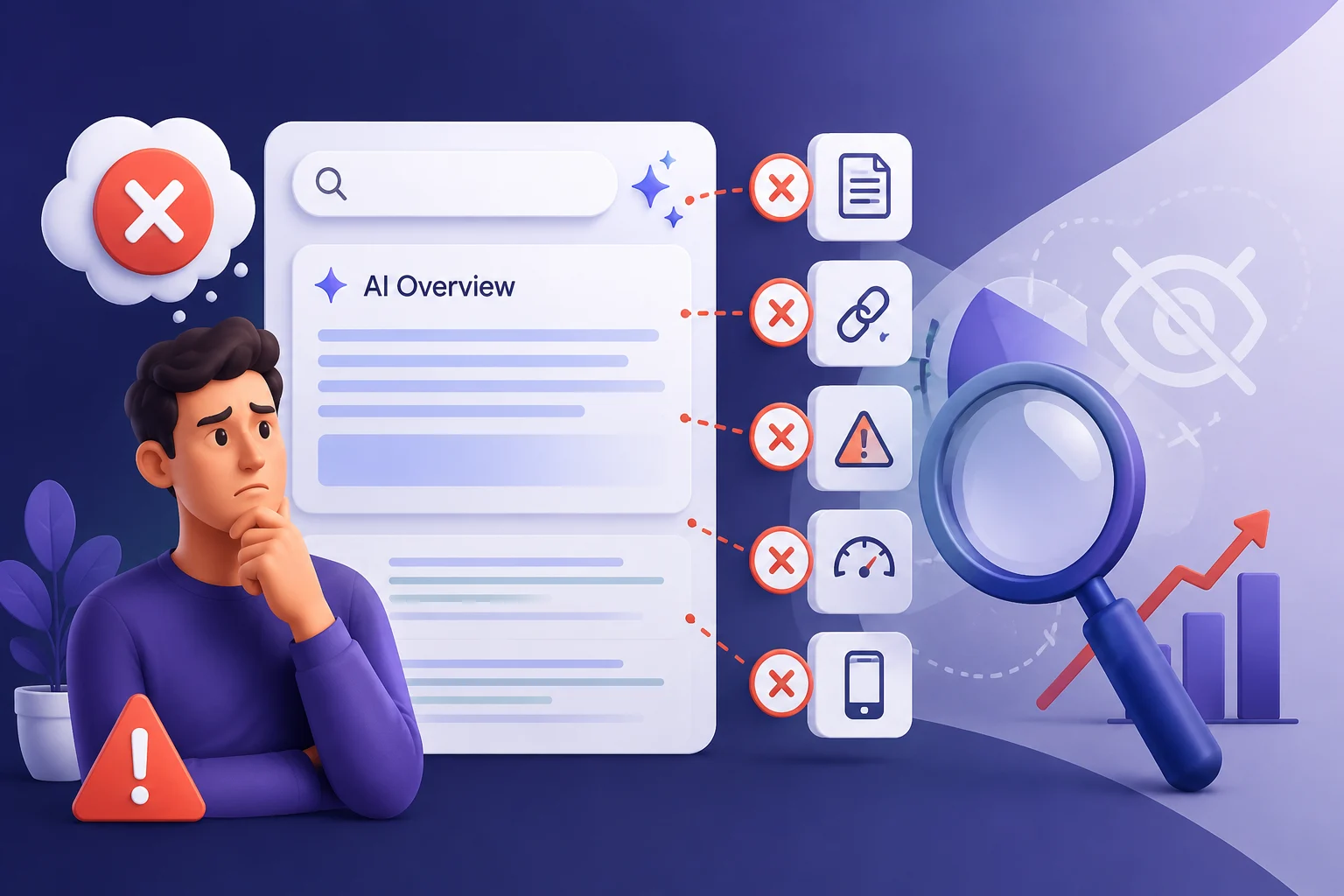
You are checking out your blog; it has a good Google ranking. However, it is not in the Google AI overviews. Why is it missing from the AIO? Are you making any mistakes?
Yes, besides traditional SEO, AI overview SEO has become crucial. Both techniques intersect; however, you have to go the extra mile where many businesses lag behind. This may include technical issues, user experience problems, or using incorrect index tags, which can make AI bots unable to crawl your content.
If your content does not give clear answers in the content or if you fail to create trust signals using entity SEO, it’s definitely a mistake. This may include ignoring building brand mentions, or sentiment analysis, citations on branded listings. You should also not assume platform equality when testing citations on Google AI, ChatGPT, or Claude.
In this blog, we’ll look at some of the most common AI search optimization mistakes. These may stop websites from appearing in AI Overviews. Fixing these problems can improve your chances of earning better visibility and bringing more organic traffic to your site.
Key Takeaways
- AI Overviews rewards websites that signal trust and authority, not just those with high rankings.
- Strong technical SEO, structured content, and consistent brand information all work together to improve AI visibility.
- Building authority beyond your website through brand mentions, citations, and digital PR helps AI trust your content.
- The best long-term AI SEO strategy is simple: create helpful content that answers real questions and gives people a reason to trust your brand.
Common AI Overview SEO Mistakes and How to Fix Them
| Common Mistake | How It Hurts AI Visibility | Quick Fix |
|---|---|---|
| Unstructured content | AI struggles to understand and extract answers. | Use clear headings, question-based sections, bullet points, and schema markup. |
| Incorrect index tags | AI and search engines may not crawl or index your pages. | Make sure important pages are set to index and monitor them in Google Search Console. |
| Ignoring technical SEO | Slow, broken, or hard-to-crawl websites are less likely to be trusted. | Improve page speed, fix crawl errors, optimize Core Web Vitals, and keep your site mobile-friendly. |
| Inconsistent brand information | AI may not trust your business if details differ across the web. | Keep your business name, services, and other information consistent on every platform. |
| Weak off-site brand presence | AI finds fewer trust signals about your brand. | Build brand mentions through digital PR, guest posts, reviews, and trusted directories. |
| Using traditional ranking logic | AI doesn’t choose content based only on rankings. | Focus on creating helpful, trustworthy, and easy-to-cite content. |
| Ignoring search intent and E-E-A-T | AI prefers content that demonstrates expertise and answers real user questions. | Publish original insights, update content regularly, and share real-world experience. |
The AI Overview: Mistakes That Can Affect AI Visibility in 2026
Your Website Does Not Have Structured Content for AI Readability
If your content is not structured for clarity, AI will not read your site. As a result, there will be no chance of citation or have AI visibility issue. Most brands make this mistake. The AI does not interpret, cite, recommend, or pull answers from your content.
Here is the fix:
- Give the exact and clear answer to the question content in the first paragraph.
- Create an author bio section to say who wrote it.
- Maintain a clear hierarchy using headings, bullet points, and visual structure.
- Write the heading just like how users use phrases
- Use question-focused H2, H3
- Use schema mark up to include structure content ( FAQ schema, article schema, breadcrumb schema, Personal schema, local business scheme)
- Break the content into a quotable structure. Make each paragraph directly focus on specific context.
- Interlink your blogs to relevant service pages or other blogs
- Use descriptive anchor text and use 1 to 2 external links to highly authoritative sites (Govt. sites, well-known research papers, quotes from industry experts, etc.)
You have not Set Index Tags Properly
One of the major mistakes brands commit is that they sometimes accidentally set index tags to the most valuable pages. AI bots and search engines may skip them completely in those cases.
Here is the Fix
- Check that your important pages are set to “index” instead of “no-index.”
- Review your SEO plugin or website settings frequently
- Use tools like Google Search Console to keep track of page indexing
- After making changes, request Google to re-crawl the page so it can update the index more quickly.
Ignoring the Technical SEO
Technical optimization is insanely crucial for AI overview SEO. Most brands get into this trap of the biggest AI search optimization mistakes. They find it time saving.
Their content is on point, and their web design looks seamless; still, they lose traffic to competitors.
If your website has technical problems like slow page speed, poor mobile experience, or crawl errors, it’s less likely it will be trusted by AI.
Here is the Fix
- Improve your website’s performance by optimizing core web vitals
- Make sure your website is mobile experience-friendly
- The website quickly loads on any device
- Inspect and fix broken links and redirect errors
- Submit an updated XML sitemap and monitor indexing in Google Search Console.
- Use HTTPS to keep your website secure.
- Plus, fix the crawling issues and structured data as we told you before
Inconsistent Brand Information and Identity
AI will not rely on a single source. It aims to provide the safest and most trusted information to users. That’s why, whenever it chooses a source, it gets confirmed with the trust sign. It will cross-check the same information from multiple sources like listings, high-authority third-party sites from your domains.
Here is the fix:
- Improve your entity SEO on your website. Build separate team pages, about us pages, and accreditations
- Provide matching and exact brand information on directories, GBPs, LinkedIn, Crunchbase, and social media profiles
- As your services grow, adjust the information as per across all sites. Maintain the matching information in all sources from where AI models refer or extract answers.
Your Brand is Not Getting Any Mention in Trusted Sources
What are your niche authorities talking about your brand? Are they even mentioning anything about your brand? If no, it’s a major AI visibility issue. All it means is you are not creating a brand impression across the web. Your brand will likely to get missed by AI.
Here is the Fix:
- Publish digital PR in credible publication sites in your niche
- Build unlinked brand mentions in social media
- Ask industry publications cover your event on news portals
- Ask customers to share reviews [mentioning your brand name]on community forums and third-party platforms
- Attend podcasts, get brand mentions as attendees of an industrial summit on organizers’ website
- Write guest posts, articles, and publish comparison listicles
Applying Ranking Logic to AI Searches
AI SEO does not give rankings. It looks for relevance and a clear or direct answer. So the ranking logic that we use in traditional SEO will not work here. It picks content based on prominence.
Here is the fix:
- Focus on creating accurate, helpful, and original content that answers real questions.
- Build trust by showing expertise and keeping your information up to date.
- Cover topics in depth instead of targeting only one keyword.
- Strengthen your brand with quality backlinks, citations, and mentions from trusted websites.
- Track how often your brand or content appears in AI answers, not just where you rank in traditional search results.
Your content is not optimized for Intent or EEAT Signals
Writing only for keywords will not work. EEAT has become the new trust signal. Generative engines or Google AI search algorithm looks for freshness in content. It prioritizes authority and value.
Does your content match the other available sources? Probably AI will ignore it.
Here is the fix:
- Publish original content and research
- Share fresh perspective and take a clear stand on core industry topics
- Refresh the thin content with elevated research
- Give credentials to industry experts
- Share firsthand experience and practical advice
- Link your content to real case studies
Final Thought
The advent of AI Overview has transformed how users search for and discover content online. Traditional SEO is not being replaced, but it has become less effective as a primary means of generating new traffic to sites since it does nothing to help your site rank high anymore!
Instead, you must create content that meets the needs of the user – that is, is easy to read, technically correct, credible, and useful to the user.
Create authoritative content that answers specific questions posed by a unique user as opposed to creating “noise” designed to achieve higher SEO rankings. Establishing yourself as a credible source of information through relationship building, answering real customer inquiries, and working to build a strong brand both on the web and offline will be a significant long-term solution to increasing visibility through AI-based search engine ranking systems.
Choose our AI SEO services now to fix all mistakes before your competitors. Book a free 1: 1 consultation today!
Frequently Asked Questions
Is it costly to fix AI Overview mistakes?
Not always. Many AI Overview improvements, such as updating your content structure, fixing index settings, improving internal links, adding schema markup, and correcting technical SEO issues, require more time than money. Building long-term authority through quality content, digital PR, and brand mentions takes ongoing effort, but it doesn't always require a large budget.