+1 6477241694
 +44 2039 960 991
 +91 78900 99810


Healthcare Google Ads conversion tracking errors lead to significant budget waste for most companies. For example, if a Google ad practice counts only form submissions, it undercounts lead volume. Call tracking errors, tracking the wrong actions like page views, generic form fills, or unqualified calls, can also lead to incorrect conversion tracking in your healthcare PPC ad campaigns. Keep reading this blog. Here, we will talk about the common Google Ads tracking problems in the healthcare industry and fixes.
Quick Answer
Healthcare businesses struggle with Google Ads conversion tracking because of common mistakes. Most organizations count the wrong events, like filling out forms for email subscriptions, as a conversion for a sale. Sometimes, call tracking issues also lead to conversion tracking problems. Treating all leads the same is another mistake in health care advertising. Wrong technical setups, compliance related health care privacy often restricts conversion tracking. A lengthy customer journey also misleads the marketing analytics.
Key Takeaways
- Accurate Google Ads conversion tracking helps healthcare businesses reduce wasted ad spend and measure genuine patient enquiries.
- Incorrect GTM setups, duplicate events, missed form submissions and call tracking errors can lead to misleading conversion data.
- Healthcare advertisers must follow privacy requirements and protect sensitive patient information when setting up tracking.
- Regular tracking audits, correct conversion settings and GA4 integration help improve campaign measurement and advertising decisions.
Read our blog on fixing Google ads conversion tracking.
Healthcare Google Ads Conversion Tracking Problems and Fix

Problem 1: Healthcare Data Privacy Restrictions
Collection of useful conversion data is one of the biggest challenges for healthcare advertisers. As there is a risk of patient information exposure, it is often non-compliance with privacy rules.
For example: Imagine a mental health clinic runs Google Ads to attract new patients for depression therapy. A visitor clicks an ad and lands on the clinic’s /appointments/depression-therapy page. They fill out an appointment form with their name, email address, or any other details about their mental health concerns.
When the visitor submits the form, an incorrectly configured Google Ads pixel may transmit the page URL, form activity, or other identifying information to Google. This could expose sensitive health information and create a HIPAA compliance risk if the clinic is a covered entity.
Google’s Customer Data Policies specifically restrict using conversions related to sensitive categories. This includes medical services, prescription drugs, and medical devices.
How to fix it
- Review all conversion tags installed on the healthcare website.
- Identify whether any tags collect patient details, medical conditions, or treatment-related information.
- CRM integrations and audience lists are not shared improperly.
- Avoid sending medical information, appointment notes, symptoms, or other sensitive patient data to Google Ads.
- Consult an expert Google Ads professional to check whether the tracking setup meets the applicable legal requirements.

Struggling With Google Ads Conversion Tracking?
Problem 2: Incorrect Google Tag Manager Configuration
GTM, or Google Tag Manager, is a tracking code. So, if there is any issue with GTM, then Google Ads tracking problems can also happen. For example, a patient completes an appointment request form. The website displays a confirmation message, but the Google Ads conversion tag does not fire. Google Ads receives no conversion signal. This can happen for several reasons. There can be configuration errors, or the conversion linker tag may be missing. Such issues can also happen if multiple GTM containers are installed on the same website.
How to fix it:
- Check whether the Conversion Linker tag is configured correctly.
- Use Google Tag Assistant to test the conversion event.
- Remove outdated or duplicate tracking codes.
- Open your Google Tag Manager tool.
- Check whether you have already installed the Google tag on your website.
- Check that the conversion ID and label are the same as those set up in Google Ads.
- Ensure the Conversion Linker tag is set up correctly.
- Use Google Tag Assistant to test that the conversion event is working.
- Remove any old or duplicate tracking code.

Problem 3: Wrong Events Tracked as Conversions
Tracking wrong activities as conversions can also be a healthcare PPC tracking issue. So, what are those things? Tracking the wrong action as a conversion, like a portal or newsletter sign-up, as a conversion. A high-intent inquiry or consultation booking request can be a valuable conversion. See, signing up to download a treatment guide or submitting an appointment request.
How to fix it?
Separate conversions according to their business value. For example, an appointment request is a primary classification. Brochure download or email subscription is a secondary classification.

Problem 4: Phone Call Conversions Are Not Tracked Properly
Many patient journeys begin with a call; however, various call tracking issues can happen without call tracking, and campaigns cannot distinguish a booking call from a routine inquiry. Why does this happen? The minimum call duration may be too high. For example, a clinic sets a 90-second minimum call duration. A patient calls, speaks to the receptionist for 60 seconds, and books an appointment. Google Ads does not count the call because it falls below the threshold.
The tracking system only records clicks on phone numbers, not actual calls. Third-party call tracking software is not integrated properly.
How to fix it:
There are several ways to improve call tracking.
| Tracking method | What it measures | Recommended action |
| Calls from ads | Calls directly from call ads and assets | Enable call reporting |
| Calls from website | Calls after an ad visitor reaches the website | Configure website call conversion tracking |
| Clicks on phone numbers | Clicks on mobile phone links | Track as a separate engagement event |
| Imported call conversions | Qualified calls recorded in another system | Integrate approved call conversion data |
Problem 5: GA4 and Google Ads Report Different Conversion Numbers
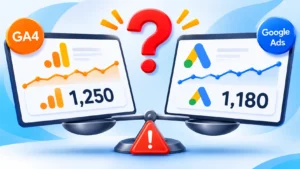
Sometimes Healthcare Marketers will expect Google Ads and GA4 to show the exact same number of conversions. This is because they operate differently with different attribution tracking set up.
For example:
- Google Ads reports conversions attributed to eligible ad interactions.
- GA4 reports events and conversions according to its configured attribution model.
- Different attribution windows can produce different results.
- Time-zone differences can affect daily reports.
- Consent choices and tracking restrictions can affect the data available to each platform.
- Therefore, a difference between the two reports does not automatically mean that tracking is broken.
How to fix it
- Link the GA4 property to Google Ads.
- Ensure Events are set up as important events in GA4.
- Verify the attribution configurations between GA4 and Google Ads.
- Date ranges and time zones should match.
- Avoid duplicate imports of conversion actions.
- Google Ads should be used as the main point of reference for conversion actions in your campaigns.
Read this blog on GA4 and Google Ads show different numbers.
Final Thoughts
Having issues with healthcare Google Ads conversion tracking can cause problems for healthcare businesses growth. It makes it harder to understand where their advertising budget is being spent and how effective their advertising campaigns are at generating real patient inquiries. This could be due to incorrect GTM setup, missed phone calls, differences within GA4 reporting, and healthcare data privacy. These can have an impact on your campaigns.
To avoid issues with your tracking, ensure you set this up correctly. Ensure you’re tracking the right actions, testing appointment forms, and ensuring phone call conversions are working. Ensure your Google Ads and GA4 are set up correctly. Lastly, ensure you’re protecting sensitive patient data.
By getting accurate conversions, you’re helping healthcare businesses make more informed advertising decisions, avoid wasted spend, and link marketing to real patient inquiries.
If you need help regarding health care PPC, the TTC team has been helping leading companies in this industry for years. We offer a transparent process where our experts work as an extended team for your company.
Feel free to book a free consultation with us!
Is Your Google Ads Tracking Broken?
Frequently Asked Questions
Does HIPAA affect Google Ads conversion tracking?
Yes. HIPAA may impact US healthcare providers using advertising tracking tools to gather and share patient information. You should ensure that you’re not sharing PHI with advertising platforms without having a suitable legal basis in place.
How can healthcare businesses track phone calls from Google Ads?
Healthcare businesses can use Google Ads call reports, website call conversion tracking, and appropriate third-party call tracking software. They should also experiment with call tracking and realistic call time limits.
What conversions should healthcare businesses track in Google Ads?
You should place primary emphasis on valuable calls to action like booking appointments and qualified calls. Subscribing to your newsletter, downloading brochures, and viewing pages should be secondary actions.
Why are Google Ads and GA4 showing different conversion numbers?
Google Ads and GA4 are set up with different attribution models, reporting methods, and conversion settings. Time zone, attribution window, and consent settings can also cause variations.
Can healthcare businesses use Google Ads remarketing?
Healthcare advertisers face restrictions on personalized advertising and audience targeting. They should review Google's healthcare-related advertising policies before using website visitor lists, customer lists, or remarketing audiences.
How often should healthcare businesses audit Google Ads conversion tracking?
Healthcare companies should ensure that conversion tracking is regularly audited and tested following any website redesign, booking system changes, tag changes, and/or consent changes. An audit once a month can help to spot any issues.