+1 6477241694
 +44 2039 960 991
 +91 78900 99810
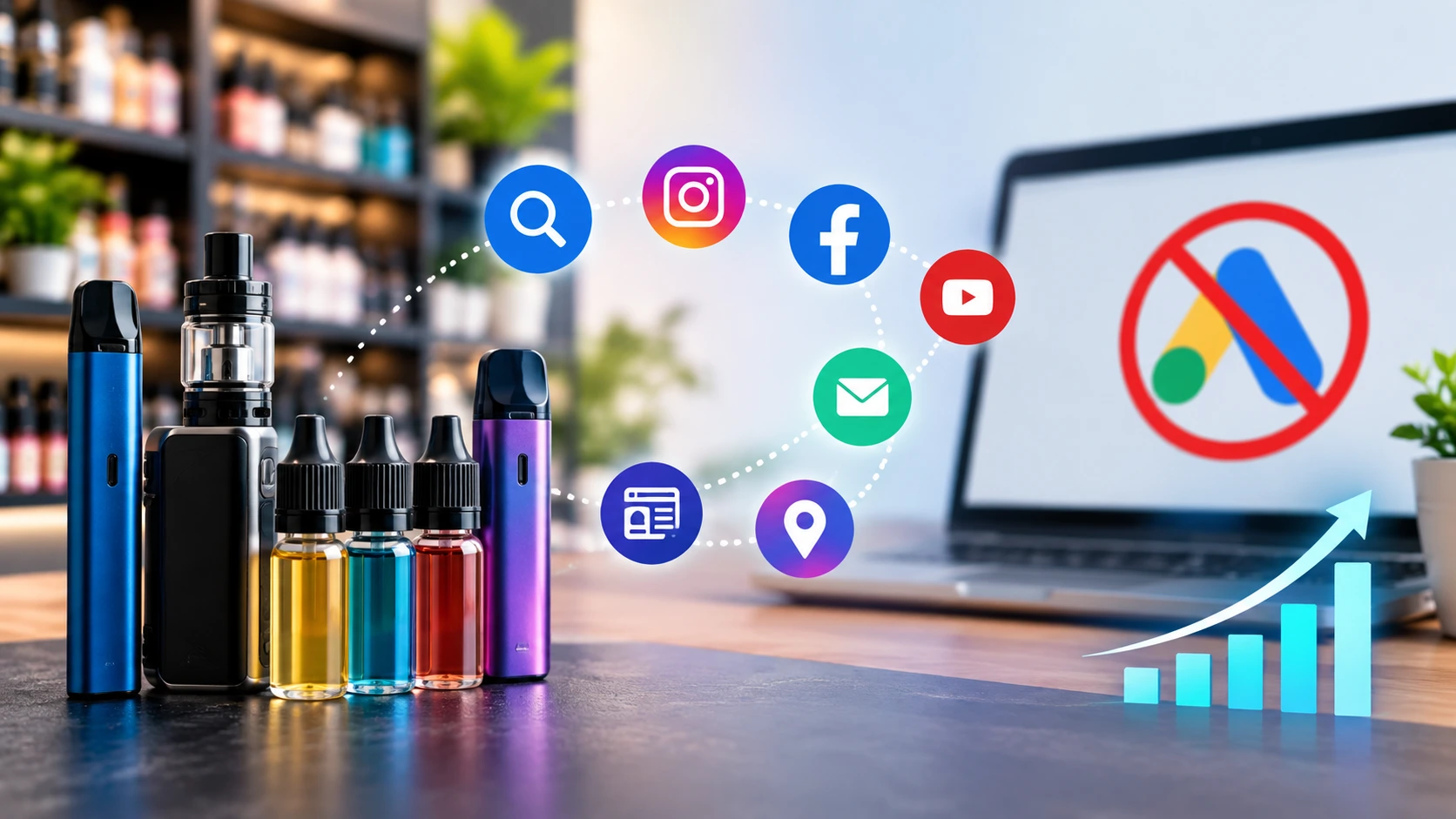
Vape shop marketing online is difficult for one main reason: many of the usual digital marketing channels are restricted for nicotine and vaping products. You may have a good website, competitive prices, and products people are looking for, but that does not mean you can promote them through Google Ads, Meta Ads, or other major advertising platforms.
The rules also do not stop at advertising. Vape businesses may need to follow age-verification requirements, product restrictions, and different regulations based on where they operate. A vape marketing strategy that works in one market may not be allowed in another.
So, how can an online vape store attract customers? How can they do it without putting their website, advertising accounts, or business at risk?
An experienced digital marketing agency like us can give you better strategic options. We have managed several B2B and B2C ecommerce accounts across India, Europe, and the USA. We suggest building a marketing strategy around the channels and methods that are actually permitted. This means understanding platform policies first, then using compliant approaches; we mainly use organic marketing like SEO, useful content, email marketing where permitted, and other suitable acquisition methods.
In this guide, we will look at what vape businesses need to know before promoting their products online, including the marketing methods that may be restricted and the safer alternatives to consider.
Key Takeaways
- Check the advertising rules for every country or region you target before launching a campaign.
- Build your SEO strategy around useful, factual content and well-optimized product and category pages.
- Fix your technical SEO by improving crawlability, indexation, site speed, mobile UX, internal links, and structured data.
- Strengthen local SEO by completing your Google Business Profile, collecting genuine reviews, and building relevant local listings.
- Build channels you control by collecting consent-based adult email subscribers and developing customer relationships beyond paid platforms.
A Compliant Vape Marketing Plan Structure That Every Beginner Should Know
| Growth channel | Primary role | Why it matters |
| Organic search and educational content | Attract people researching solutions and products through unpaid search results | Builds long-term visibility, captures high-intent traffic, and remains less dependent on advertising approvals |
| Permitted paid search campaigns | Generate immediate visibility for products and services allowed under advertising policies | Provides targeted reach, but every product, keyword, landing page, and campaign must be reviewed for compliance |
| Customer email and SMS | Encourage repeat purchases, replenishment orders, and customer engagement | Gives you direct access to an opted-in audience and can improve retention without relying entirely on third-party platforms |
| Brand visibility and public trust | Increase branded searches, referrals, direct visits, and customer confidence | A strong reputation supports conversion across every channel and reduces the risk of losing demand when platform rules change |
Let’s Understand the Real Problem by Taking a Real Example
If you run a vape store in the US, Google Ads is not a channel you can simply switch on. Google’s current advertising policy lists electronic cigarettes and e-cigarettes among products that cannot be promoted through Google Ads. The restriction also covers products designed to simulate tobacco smoking. (For example, imagine a US vape retailer selling nicotine e-liquids, vape pods, disposable vapes, and mods. A customer searching for “buy nicotine vape pods online” may show very strong purchase intent. But that does not make the search eligible for a Google Shopping or Search campaign. The retailer cannot simply create an ad for the product, send the visitor to a product page, and expect the campaign to run.
Trying to hide the product does not solve the problem either. Changing the wording, using a different landing page, or promoting a related product with the intention of driving people toward prohibited vape products can still create policy problems.
Google treats violations seriously, and its tobacco policy says an account will receive a warning before suspension rather than being suspended immediately for a first violation.
That creates an important marketing lesson: high buyer intent does not always mean paid search is available to you. For a vape retailer, the question is not simply, “What keyword should I bid on?” It is, “Can this product and this type of promotion legally and platform-wise run on this channel?”
This is where copying a US strategy into another market can lead you in the wrong direction.
The UK has its own advertising framework for e-cigarettes. Under the CAP Code, marketing communications for nicotine-containing e-cigarettes and their components that are not licensed as medicines are prohibited in certain media. There is limited scope for factual information on a retailer’s own website and certain non-paid online spaces under its control, provided the content does not become promotional.
For example, the website of the retailer could include factual information about the products, but the use of language like “the vape you must try” on the very same website for promotional purposes is crossing the line. ASA has also differentiated between factual information and promotion.
UK marketers also need to consider rules around age and audience. Ads must not be directed at under-18s, content should not have particular appeal to children, and people using or playing a significant role in vape advertising must not be or appear to be under 25.
How Can You Plan Compliant Vape Marketing?
Start by Accepting the Rules
Google has separate rules that vary by country. You can’t bid your way around it. However, the rules vary by country.
So, first know the advertising rules in the location you are targeting. Understand locational requirements first.
Some people will tell you there’s a trick. They may offer to hide your products behind a different landing page or reword your ads. Don’t listen. These tricks get caught, and the result can be a permanent ban on your Google account.
Once you accept this, you can stop wasting money and start building something that lasts.
Make SEO your Main Channel
When paid ads are blocked, search results are where you win. SEO is one of the oldest forms of online marketing, and it is still evolving. Do you know the best part? It has a lot of potential as it brings organic and sustainable growth to brands. Hence, your vape store is worth SEO.
People still search for devices, flavours, comparisons, and shops. You just need to show up there. However, as your competitors are still racing on the same, ranking on organic search will not be so easy.
Write content that answers real questions; we make the most of it. That’s how we bring high-intent customers to the first line of contact, i.e the website.
We use educational material, mostly. Each article educates customers, builds trust, and can rank for years. That’s why it brings a stream of leads.
Give every product and category page its own clear description too. Don’t copy the supplier’s text.
One rule here: skip health claims. Don’t say a product helps people quit smoking or is “safer.” Stick to facts about how products work. Read this blog to write engaging vape product copies.
Make Sure Your Technical SEO and UX Are Top Notch
This is the low-hanging fruit in vape online marketing. Why? See, this is the place where things are predictable. You need to follow a few principles of technical SEO and UX.
Here is a table you need to follow:
| Technical SEO / UX Principle | What a Vape Brand Should Do | Why It Matters |
| Crawlability | Make sure important pages can be crawled. Check robots.txt, XML sitemaps, internal links, and blocked resources. | Search engines need to discover and understand your website. |
| Indexation control | Check which product, category, blog, filter, and search pages should be indexed. Use noindex where appropriate for low-value or duplicate pages. | Helps prevent unnecessary or duplicate URLs from entering the search index. |
| XML sitemap | Keep an updated XML sitemap containing the important canonical URLs you want search engines to discover. | Makes it easier for search engines to find key pages. |
| Canonical tags | Add correct canonical URLs to product, category, and other pages that may have URL variations. | Helps search engines identify the preferred version of a page. |
| URL structure | Use short, descriptive URLs that clearly show the page topic. Avoid unnecessary parameters and complicated URL structures. | Makes URLs easier for users and search engines to understand. |
| Internal linking | Connect relevant category, product, educational, and support pages with natural internal links. | Helps users navigate the site and helps search engines understand page relationships. |
| Site architecture | Keep important products and categories within a reasonable number of clicks from the homepage. | A clear structure improves navigation and makes important pages easier to discover. |
| Page titles | Write unique, descriptive title tags for important pages without keyword stuffing. | Helps search engines and users understand what each page is about. |
| Meta descriptions | Create useful, unique descriptions that accurately represent the page and follow applicable advertising and regulatory rules. | Can help users understand the page before clicking from search results. |
| Heading structure | Use one clear H1 and logical H2/H3 headings. Keep headings descriptive rather than stuffing keywords into them. | Creates a clear content structure for users and search engines. |
| Product page SEO | Provide useful, accurate product information. Avoid unsupported health, safety, or cessation claims. | Gives users useful information while reducing the risk of misleading claims. |
| Structured data | Use relevant Schema.org markup where eligible, such as Product, BreadcrumbList, or Organization. Keep the markup consistent with visible page content. | Helps search engines better understand page information and may make pages eligible for certain search features. |
| Core Web Vitals | Improve loading performance, interaction speed, and visual stability. Pay attention to LCP, INP, and CLS. | A faster, more stable website creates a better user experience. |
| Mobile SEO | Build a responsive website with easy-to-use menus, readable text, accessible buttons, and a simple checkout experience. | Mobile usability is important for both visitors and search visibility. |
| HTTPS | Use HTTPS across the entire website, including product, account, and checkout pages. | Protects data in transit and creates a more secure browsing experience. |
| 404 and redirect management | Fix broken internal links and use relevant 301 redirects when pages or products are permanently moved. | Prevents users from landing on dead pages and helps preserve useful URL signals. |
| Faceted navigation | Control URLs created by filters such as brand, flavour, nicotine strength, size, or price. | Large numbers of filter URLs can create crawl and indexation problems. |
| Pagination | Make category and product listing pages easy to crawl and navigate. Use consistent internal linking between pages. | Helps search engines discover products deeper in the catalogue. |
| Image SEO | Compress images, use descriptive filenames and appropriate alt text, and avoid unnecessarily large files. | Improves page speed and helps search engines understand images. |
| Content quality | Publish genuinely useful educational content instead of creating large numbers of thin pages targeting similar keywords. | Helps build a useful site rather than a collection of pages made only for search traffic. |
| Duplicate content | Avoid creating separate pages with almost identical descriptions for similar products. Write useful, distinct information where pages need to exist separately. | Reduces duplication and gives each important page a clear purpose. |
| E-commerce filters and search | Make onsite search and filters useful while controlling whether automatically generated URLs are indexable. | Improves UX without creating thousands of low-value search URLs. |
| Analytics and monitoring | Monitor organic traffic, indexation, crawl errors, conversions, page speed, and important technical changes. | Helps identify SEO problems before they affect the store significantly. |
| Age verification UX | Use an appropriate age-verification system where required and make the process clear without unnecessarily blocking legitimate users. | Age-restricted products require additional compliance considerations. |
| Location-based rules | Account for differences in laws, product availability, shipping restrictions, and website requirements by market. | A page or product permitted in one location may not be permitted in another. |
| Compliance pages | Keep relevant shipping, returns, privacy, terms, age restrictions, and regulatory information easy to find. | Improves transparency and helps users understand the store’s requirements. |
| Accessibility | Use readable contrast, keyboard-friendly navigation, descriptive labels, accessible forms, and meaningful alt text. | Makes the store easier for more users to navigate and complete purchases. |
Read our blog on technical SEO problems that can kill rankings.
Win Your Local Area
If you have a physical shop, ranking on “vape shop near me” is one of your best chances to drive new customers. Working on local SEO can really be helpful to attract high-intent customers.
It’s more like locational organic marketing that not only brings new customers but also has long-term benefits. It helps you create market demand specifically for your products, as community engagement is a part of vape marketing strategy you cannot do without it!
Here are some
- Claim and complete your Google Business Profile. Add your hours, phone number, and clear photos. Complete and verify your profiles.
- Build review volume, which search engines like Google or Bing count on. Ask happy customers for reviews, and reply to every review, good or bad.
- Get listed on trusted local directories and community sites.
- Build your social media profile. Optimize the bio and place your website link. It helps to engage your community.
Build an Email List You Own
Social profiles can be deleted. Ad accounts can be banned. Your email list is yours.
Gather emails through checkouts and in-store, but only from validated adults. Then send valuable emails: welcome emails, out-of-stock emails, care tips, and birthday deals. People in this group tend to shop more frequently, and that’s how you cn improve the repeat sales.
Do your research first on SMS marketing. It may be limited when it comes to vaping products.
However, make sure, you are aware of the legal requirements. In the UK and some other markets, promotions sent by email can be restricted for e-cigarettes.
Reward Your Regulars
A loyalty program is cheap and works well. Points for each purchase, small perks at higher spending levels, or early access to new arrivals all keep people coming back.
It also gives you something else that’s valuable: data. You learn who buys what and when, so your offers get smarter.
Use Events and Local Partners
Run a device care workshop or a launch night for a new product. Customers come, bring friends, and talk to your staff face to face. Collect contact details with permission and follow up afterward.
You can also team up with nearby businesses that share your customers, like cafes, barber shops, or record stores. A shared giveaway or a small display in each other’s shop costs very little.
Be Careful on Social Media
Social media can be used for organic posts in most places, but the regulations vary from place to place and platform to platform. In some countries, even an ordinary post qualifies as an advertisement.
- In case you post, remember these practices:
- Focus on educating your customers, rather than making a hard sell.
- Showcase expertise and try to build a unique community for you
- Age-gate your social media pages and website wherever possible.
- Never use cartoon characters or youth language in any form.
- Respond to queries and comments faster in forums and communities.
Be aware of the each platform’s own policy and regulations.
Let Your Sales Data Guide You
POS tells you which products sell quickly and which do not. Your best-selling items should be highlighted in your email communications. Combine your slow-moving products with best-selling products. Ensure that you stock up on favourite products before any peak seasons arrive.
Conclusion
Marketing a vape shop without Google Ads is slower to start, but it’s more stable. You build search traffic, a local reputation and an email list that no platform can take away.
Start small. Fix your Google Business Profile this week. Write one helpful article next week. Add an email sign-up at checkout. Then build from there.
Laws about selling and promoting vape products differ a lot by country, and in some places selling them is not allowed at all. Always check your local regulations before you market anything.
Book a free consultation today with our expert if you need any help with compliant vape marketing!
Frequently Asked Questions
How Will SEO Bring Customers to your vape store?
SEO allows your shop to show up when people search for a product, comparison, question, or local vape shop. Create valuable educational content and optimize all key pages such as your main products, and categories. Don't make unsupported health or smoking-cessation claims, and focus on factual product information.
What level of technical SEO should a vape website have?
Start with the basics: allow your content to be crawled, control indexation, maintain an XML sitemap, use canonical tags, use a logical URL structure and create internal links. Further improve Core Web Vitals, mobile friendliness, structured data, images, redirects, Faceted Navigation and page structure. For a Vape site – age-verification UX and geo-compliance should be taken into consideration along with general site UX.
Is it okay to sell my vape on social media?
Different by country, platform, type of content… If you're not paying for an ad, don't presume that an organic post is approved. If you're in social media, prioritize factual, educational, or informative content, use none of the language or images that appeal to children, and check the rules that are relevant in your country and for your platform.
How do I ensure my marketing efforts are compliant?
Begin with the rules that exist everywhere you're considering marketing. Research rules around advertising, age limits, product limits, ship rules, health claims, and any content used in advertising before your ad goes live or campaign launches. Avoid simply looking to another nation as a benchmark and believing you can just "copy and paste" what they're doing into your own marketing. When in doubt, ask a legal or regulatory expert in your jurisdiction!